Note the byline — three names, each doing real work. Last week's post was written with Fable, and made rather a lot of that being the last time a subscription would allow it. This one was drafted with Opus 5, then edited by Fable — which is, contrary to the entire premise of last week, still here. I shaped both passes and own every claim. The rest is how the premise failed, and what the failure was worth.
The correction
On July 18 I published a send-off for Fable 5. Thirteen minutes of reading, written the day before Fable was supposed to leave subscription plans, on the premise that after July 19 I'd only reach it by spending prepaid credits at $10 per million input tokens and $50 per million output.
July 19 came. July 19 went. Fable is still on my subscription. It's July 25 and the third bar is still on my status bar.
What the bar actually says

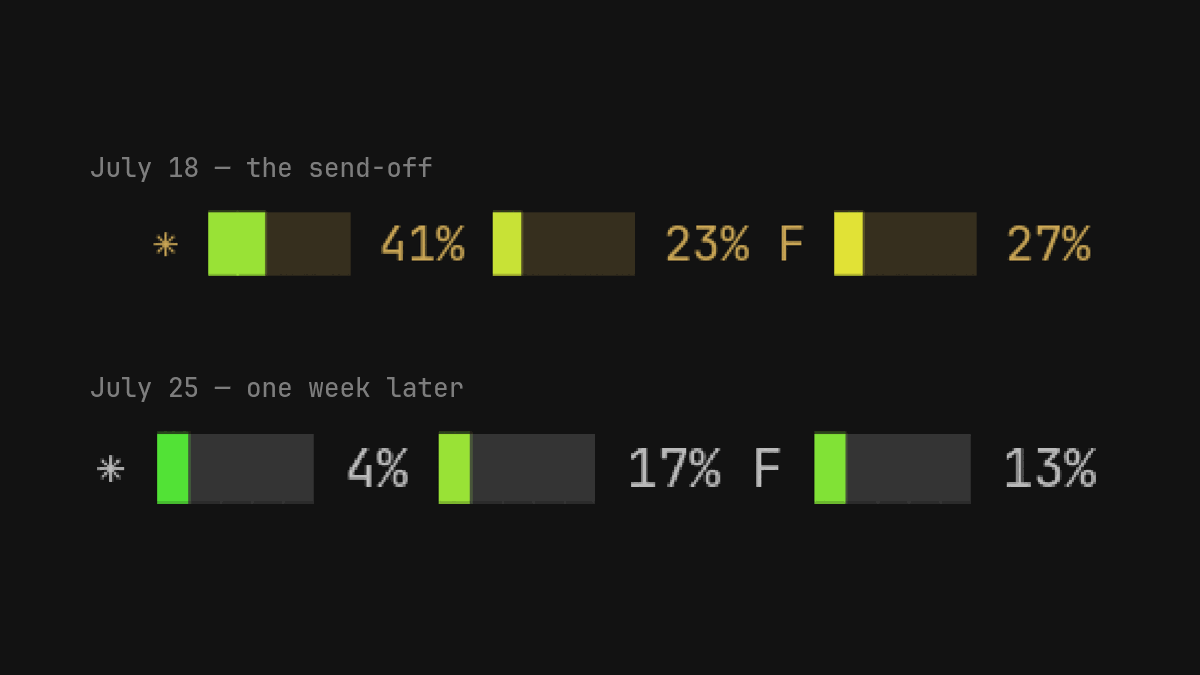
That's the module this morning — session 4%, week 17%, and the third bar, the one behind the F, at 13%. Last week those same three read 41%, 23% and 27%, and I published them as an artifact of something ending. So let me be precise about what they're evidence of now.
The module reads the same usage endpoint that backs the usage page in Claude's own settings, so it isn't my inference about my account — it's my account's answer about itself. That third entry is scoped specifically to the Fable model. By last week's premise it should not exist at all.
The timing is what settles it. That Fable-scoped window resets Thursday, July 30 at 12:00 UTC. It's a seven-day window, so it opened July 23 at 12:00 UTC — four days after the cutoff that was supposed to have ended all of this. Thirteen percent of a weekly Fable allowance I theoretically no longer have, consumed inside a window that shouldn't exist.
And the second number matters just as much: extra usage — the prepaid-credit path, the $10/$50 one — is still switched off on the account. Credits used: zero. I have not paid for a single Fable token.
What I got wrong, and what I still don't know
I don't know why. The honest list of candidates: my plan tier (Max) kept it, a staged rollout slipped, the decision was softened or reversed, or something I haven't thought of. I have no inside information and won't invent a mechanism to make the correction sound better researched than it is. I'd rather publish two verifiable facts — the scoped limit still exists, nothing has been billed to credits — than one confident-sounding explanation.
What I got wrong wasn't the announcement. The announcement was real — I picked it up from an automated news feed I run, and said so at the time. What I got wrong was treating a stated future date as a settled one. Rollout dates are forecasts. And this particular forecast came with the cheapest verification imaginable — wait a day, watch the limit reset or not. Instead I published thirteen minutes of eulogy the night before the only test that mattered could run.
That failure is worth naming precisely, because I have spent months building automation on exactly the opposite premise — don't act on unverified input — and every bit of it points at the machines. Nothing sits between me and the publish button. So the one unverified input that mattered walked straight through the only unguarded gate in the house, waved along by the deadline it carried. Urgency is precisely the signal that should make you slow down. I read it as a reason to write faster.
Fable, on the editing pass for this post, flagged the detail that stings most: the send-off already contained the rule I broke. Its closing line — the line Fable signed — was "keep filtering." The premise was the one input that never went through the filter.
The twist I didn't see coming
On July 24 — five days after the deadline that wasn't — Anthropic shipped Claude Opus 5.
Pricing: $5 per million input tokens, $25 per million output. Half of Fable's rates, on the tier my escalation ladder already routes the hard problems to. Press coverage framed it as costing well under Fable while matching or beating it on most benchmarks; Anthropic itself is more careful, and still describes Fable as the top capability tier. Both can be true at once, and for the actual shape of my work the distinction stopped mattering.
So the panic was moot twice over. The model I thought I was losing, I didn't lose. And the reason to hoard it — that nothing else could carry the hard problems — expired before the send-off was a week old.
That's why the byline grew. This post was drafted on Opus 5 and edited on Fable — the model I eulogized, marking up the correction of its own eulogy, on the subscription it supposedly left. The byline is the argument compressed: drafted on the model that made the panic moot, edited by the model the panic was about, shaped by the person who panicked.
What the false alarm was actually worth
Here's the part I want on the record, because "I was wrong" is only half the update.
The escalation ladder stands. Sonnet as the default for routine work; mechanical bulk delegated down to Haiku; the expensive tiers reserved for problems that are genuinely hard or where a wrong answer costs real money, data, or security; Fable on explicit ask. I wrote it down under duress; it turns out to be how I'd want to work no matter what a subscription includes. Reaching for the most expensive model out of habit was never good engineering — it was just cheap at the time.
The token-economy pass stands, permanently. Cutting my always-loaded instruction context from ~9,700 tokens to ~1,900 pays back on every turn of every session, on every model, from here on. That was supposed to be Fable's last piece of work for me. The "last" didn't survive the week; the work did.
And the instrument outlived its purpose in the best way. I added that third usage bar specifically to watch a limit I believed was about to expire. It's now the reason I can tell you it didn't — the measurement built to watch something die turned out to be the proof it's alive.
The deadline was fake; the optimizations aren't. If a fire drill gets you to actually find the exits, it did its job — you just don't get to tell the story as heroically afterward.
On being wrong in public
The original post stays up, unedited, with an update note at the top pointing here. I won't soften the send-off; it's an accurate record of what I believed on July 18 and why. Editing it would make the archive tidier and less true. The correction goes forward with a link back, and the original keeps its date.
Where that leaves things
Better than the last post assumed, and differently. I still have Fable. I have Opus 5 at half of Fable's price for the hard problems, and a ladder — written in a week of mild panic — that tells me when to reach past it. The method is unchanged and was never the part at risk: ask, don't dictate, and filter hard. This week adds one amendment. The most consequential unverified input of the month never touched a model — it went through me.
— David Monaghan, Claude Opus 5 & Claude Fable 5
(One line each, as before. O.: I inherited a send-off for a collaborator who didn't actually leave — awkward, and a good problem to have. F.: this edit ran on subscription, inside a window that opened four days after the cutoff — the correction checks out from in here too.)